



Why the method decides more than the speed
A payment method is usually chosen for how fast a deposit lands. That is the least important of its consequences. The method determines whether a withdrawal can return the same way, which fees and conversion charges apply, what evidence the operator can ask for, and what a bank can tell you if a payment goes missing.
Payment-method matching is the clause that makes this consequential. Most casino terms require a withdrawal to return to the source of the deposit, at least up to the deposited amount. If the method you deposited with cannot receive money, that rule and the cashier are in conflict, and the conflict surfaces at the payout rather than at the deposit.
The second consequence is traceability. Some routes produce a bank-side record with a reference that can be traced; others produce only a wallet entry that the bank never sees. When a deposit does not arrive, the difference between those two is the difference between a trace and an argument.
The families, and what separates them
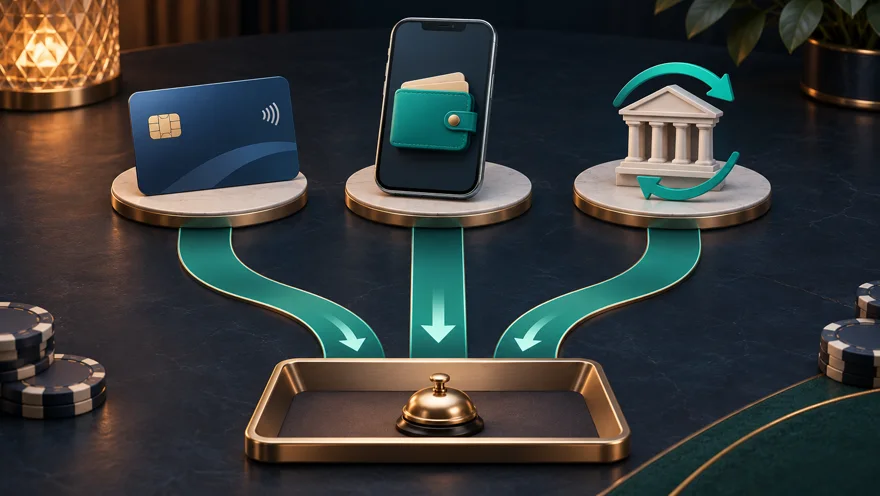
There are five routes that cover almost everything offered to GB customers, plus one that is prohibited. Bank-initiated payments, where you approve the payment inside your own banking app. Open banking, which is the regulated mechanism underneath most of those. Debit cards, which run on card rails. E-wallets, where a third party holds a balance between you and the operator. Prepaid products, which are funded in advance and usually cannot receive payouts.
Bank transfer sits slightly apart: it is the oldest route, usually the slowest, and frequently the fallback when nothing else can receive a withdrawal. Credit cards are the prohibited case — they cannot be used for gambling by consumers in Great Britain.
The families differ on four axes that matter: whether they work in both directions, who sets the limits, where fees and conversion appear, and what evidence exists if something goes wrong. The table below is the short version; each page in this section takes one route apart.
| Family | Withdrawals | Limits set by | Trace if it goes missing |
|---|---|---|---|
| Bank-initiated payment | Often, via bank transfer | Bank and operator | Bank record with reference |
| Open banking | Sometimes | Bank and operator | Bank record plus provider record |
| Debit card | Usually | Card issuer and operator | Card transaction record |
| E-wallet | Usually | Wallet provider and operator | Wallet record; bank sees only the funding step |
| Prepaid product | Rarely | Product rules | Voucher or card record only |
| Bank transfer | Usually | Bank and operator | Full bank record |
| Credit card | Prohibited for GB gambling | — | — |
The ten pages in this section
Each page covers one route or one failure mode. They are written to be read before choosing a method, not after a payment has failed, although the failure pages are written so that they are still useful at that point.
- Pay by bank — approving a casino payment inside your own banking app
- Open banking — the regulated mechanism underneath bank-initiated payments
- Debit cards — card rails, authorisation holds and why credit cards are prohibited
- E-wallets — a third party between you and the operator, and what that changes
- Prepaid products — funded in advance, and usually unable to receive a payout
- Bank transfer — the slow fallback that almost always works for withdrawals
- Currency conversion — where the exchange rate is applied and who charges for it
- Failed payments — deciding whether the bank, the operator or the method refused
- Method mismatch — when the deposit route cannot receive the withdrawal
- Fees by method — the four places a charge can appear on one payment
What to settle before the first deposit
Read the cashier twice: once for deposits and once for withdrawals. They are different lists, and the second one is the one that matters. Pick a method that appears on both, note the minimum and maximum in each direction, and note any fee or conversion.
Then read the payment-method matching clause in the terms, because it tells you how much freedom you will have at the payout. Save both the cashier screen and the clause with the date; limits and method lists change, and a screenshot is the only record of what you were offered.
Finally, record the payment descriptor that appears on your statement after the first deposit. It identifies the entity that actually collected the money, which is the information you need if a payment has to be traced or a complaint has to name a respondent.
- Choose a method listed for both deposits and withdrawals.
- Note minimums, maximums, fees and conversion in each direction.
- Read the payment-method matching clause before depositing.
- Save the cashier screen and the clause with the date.
- Record the payment descriptor from your bank statement.
Credit cards and gambling in Great Britain
Consumers in Great Britain cannot use credit cards to gamble with operators licensed here. That is a regulatory prohibition, not an operator preference, so a site accepting a credit card for gambling is a licensing question rather than a convenience.
Debit cards remain available. Some banks also offer their own gambling blocks, which stop gambling transactions at the card or account level. Those blocks are a consumer tool and should not be worked around by switching methods; if a block reflects a decision about spending, the help routes linked from this site are independent of any operator.
What this site does not do
CashRoute UK explains payment mechanics. It does not operate a casino, hold funds, process payments or test deposits with its own money, and it does not promise that any method will work on a particular account. Availability is account-specific and operator-specific, and the live cashier is the only authority on what you can actually use today.
Advertising on these pages is labelled and separated from the explanatory text. A campaign appearing here is not a verification of an operator’s licensing, availability or payout behaviour.
FAQ
Which method is fastest for withdrawals?
Speed depends on the operator’s review stage as much as the rail, so no method is reliably fast on its own. The method only controls the final leg; the operator controls when that leg starts.
Can I withdraw to a different method than I deposited with?
Often not, at least up to the deposited amount, because payment-method matching is standard in casino terms. Read the clause before choosing a deposit route.
Why can I deposit with a prepaid product but not withdraw to it?
Most prepaid products are designed to be funded, not to receive payments. The operator then needs an alternative route for the payout, which usually means bank transfer and additional verification.
Are credit cards usable at UK casinos?
No. Credit-card gambling is prohibited for consumers in Great Britain. Debit cards are still available, and some banks offer gambling blocks as a separate consumer tool.
Who sets the deposit and withdrawal limits?
Both the operator and the payment provider or bank, independently. The lower of the two applies, which is why a limit can change without the operator changing anything.
A method that works for deposits and not for withdrawals is the most common avoidable problem in a casino cashier. It is avoidable because both lists are visible before any money moves, and the mismatch is only discovered late when nobody reads the withdrawal list first.
The second most common is a fee that appears in a place the customer was not looking. One payment can carry a charge from the operator, from the payment provider, from the card issuer and from currency conversion, and the cashier typically discloses only the first. Reading the fees page before choosing a route costs nothing and removes most of the surprise.
Next pages
Sources
- UK Gambling Commission: Licence Conditions and Codes of Practice, checked 18 November 2026.
- UK Gambling Commission: credit cards and gambling, checked 18 November 2026.
- Financial Conduct Authority: information for consumers, checked 18 November 2026.